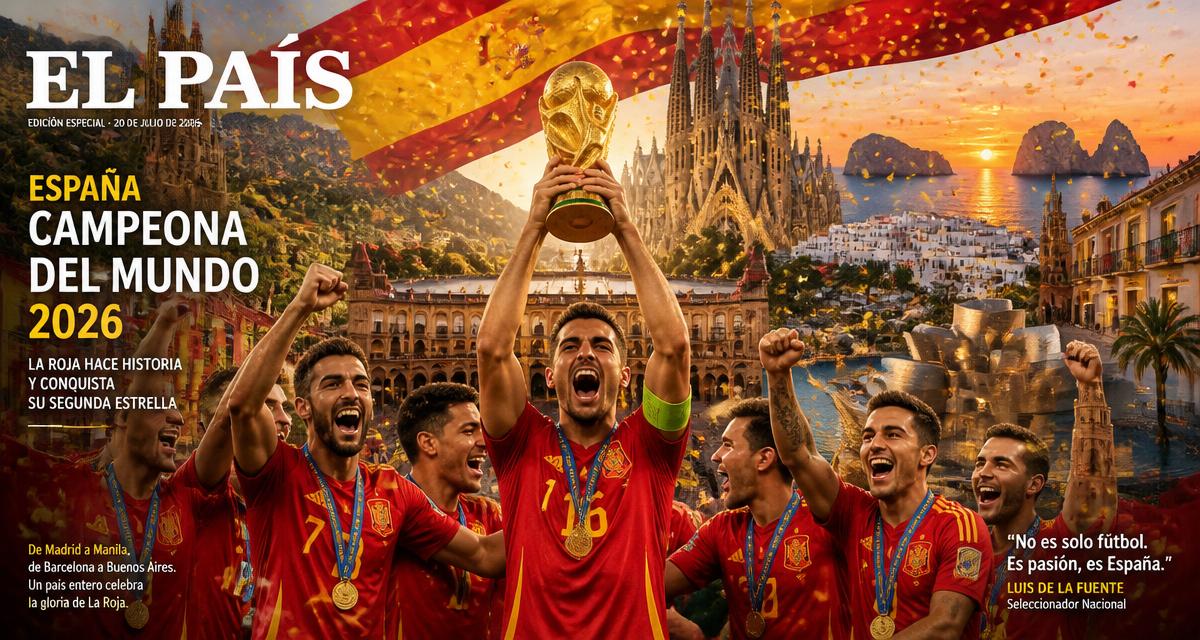
Spain has won the 2026 FIFA World Cup and the impact goes far beyond football. We analyse how winning a World Cup multiplies tourism interest, attracts American, Asian and Latin American buyers, and how this wave translates into more visits, more investment and more property purchases in a country already breaking records.
La Roja has done it again. With their victory at the 2026 World Cup hosted in the USA, Mexico and Canada, Spain not only earns its second star — it becomes, once more, the country the whole planet wants to talk about. In economic terms this is called the "emotional host-country effect": for weeks, billions of people have watched the red-and-yellow flag, heard about Spanish cities, and associated Spain with success, joy and celebration. In this deep-dive we break down, with data and real cases, how that momentum converts into tourists, investors and home buyers.
A World Cup is the most powerful nation-branding campaign on Earth
According to Nielsen Sports, the World Cup final draws over 1.5 billion global viewers and the knockout stage combined reaches more than 5 billion people. No other event on the planet matches that reach — not the Olympics, not the Super Bowl, not a US State of the Union.
For the winning country the return is double:
- Unmatched brand exposure: weeks of news, sports and emotional content tied to the country
- Positive halo effect: studies by the University of Surrey and the UNWTO show world champions increase inbound travel intent by 15-25% in the following 3 years
Real cases: what happened to the last champions
🇩🇪 Germany 2014 — Brazil
After winning in Brazil, Germany recorded a +11% jump in international arrivals in 2015 (Statistisches Bundesamt), with a spike from Brazilian, Argentine and Eastern European visitors discovering the country through football. Berlin passed 30 million overnight stays for the first time.
🇫🇷 France 2018 — Russia
Already the world's most visited country, France added 3.7 million extra tourists in 2019 (Atout France). Brand "France" rose 4 places in the Anholt-Ipsos Nation Brands Index. Foreign real-estate investment on the Côte d'Azur and Paris grew 9% YoY.
🇦🇷 Argentina 2022 — Qatar
Argentina, mid-currency-crisis, saw inbound tourism surge +72% in 2023 (INDEC), with Buenos Aires and Mendoza as the winners. Foreign property purchases in Buenos Aires grew 28% (Colegio de Escribanos), with Americans, Brazilians and Europeans capitalising on devalued prices and the "Messi effect".
🇪🇸 Spain 2010 — South Africa
The first star already left its mark. Turespaña estimated €2.5 billion in indirect advertising value. Asian arrivals grew 14% in 2011, and "Spain" cemented itself among the world's 5 most valuable nation brands.
Why Spain 2026 will be especially powerful
- USA as co-host: the American market lived the World Cup at home, with football fandom at all-time highs. MLS and English-language broadcasts have tripled tournament audience vs 2022
- American interest in Spain was already booming: +18% US visitors since 2023 (INE-FRONTUR). The World Cup accelerates the trend
- Emerging Asian and Latin American markets are discovering Spain as a long-stay and second-home destination
- Spain is already the world's most visited country (94 million in 2025), overtaking France
- Saturation media coverage: Madrid, Barcelona, Seville, Málaga and Valencia have featured constantly on global TV during the celebrations
From "I want to visit" to "I want to buy here"
- Phase 1 — Emotional interest (0-6 months): flight, hotel and "things to do" searches rise 30-60% in Google Trends
- Phase 2 — Tourism (6-24 months): first family or couple trip, often the following high season
- Phase 3 — Return and purchase (2-5 years): the visitor comes back, rents for several seasons and eventually buys a second home or investment property
UNWTO and Deloitte "sports tourism" reports document this pattern in Germany post-2014, France post-2018 and Argentina post-2022.
The American opportunity
- 3.9 million US tourists visited Spain in 2025 (+18% vs 2023)
- Average stay of 9.2 nights — well above European averages
- Average daily spend: €310, the highest among major inbound markets
- US buyers of Spanish property grew +42% between 2020 and 2025 (Colegio de Registradores)
- Favourite markets: Costa del Sol, Balearics, Barcelona, Madrid, Valencia and Alicante
66% of Americans hold no active passport (US State Department). A World Cup win can be the trigger for that first international trip, and Spain — safe, EU-standard, affordable food, iconic heritage — is the perfect "first-leap" destination.
Expected impact on the Spanish property market
- +15-20% additional international tourists over 3 years on top of the current trend
- +8-12% more non-resident purchases — especially Americans, Mexicans, Koreans and Indians
- Extra pressure on Costa del Sol, Balearics, Costa Blanca, Madrid and Barcelona
- New "World Cup effect" hubs: Seville, Bilbao, Valencia and San Sebastián
- Sustained price increases in premium zones: 4-7% per year, above the national average
What if you fall in love and buy in Spain?
- Annual imputed income on own-use properties (annual Modelo 210)
- Holiday-rental income declared annual on Modelo 210 (19% EU/EEA with deductions, 24% others)
- IBI — annual municipal property tax, separate from Modelo 210
- On sale: 3% withholding (Modelo 211) and capital-gains filing (Modelo 210)
- Double-taxation treaties between Spain and your home country prevent paying twice
At SpainTaxForm we help non-resident owners from 40+ nationalities meet all these obligations — 100% online, fixed prices, no surprises.
Bottom line
Winning a World Cup is not just a sporting party — it's the best country-marketing campaign money cannot buy. Spain starts from an enviable position: number one in global tourism, top of quality-of-life rankings, and with a property market that already attracts foreign capital. Combined with the co-hosting of World Cup 2030 and the pull of the US market, the coming decade could be the most expansive in the history of Spanish tourism and real estate.
Related guides
Sources
- 1FIFA — Official 2026 World Cup results
- 2INE — FRONTUR movimientos turísticos en frontera
- 3Turespaña — Ministerio de Industria y Turismo
- 4Nielsen Sports — Global Sports Media Consumption Report
- 5Deloitte — Football Money League & sports tourism reports
- 6UNWTO — World Tourism Organization impact of mega-events
- 7Idealista — Informes de mercado inmobiliario España
- 8Colegio de Registradores — Estadística Registral Inmobiliaria
Comments(0)
Sign in to leave a comment
Be the first to comment.