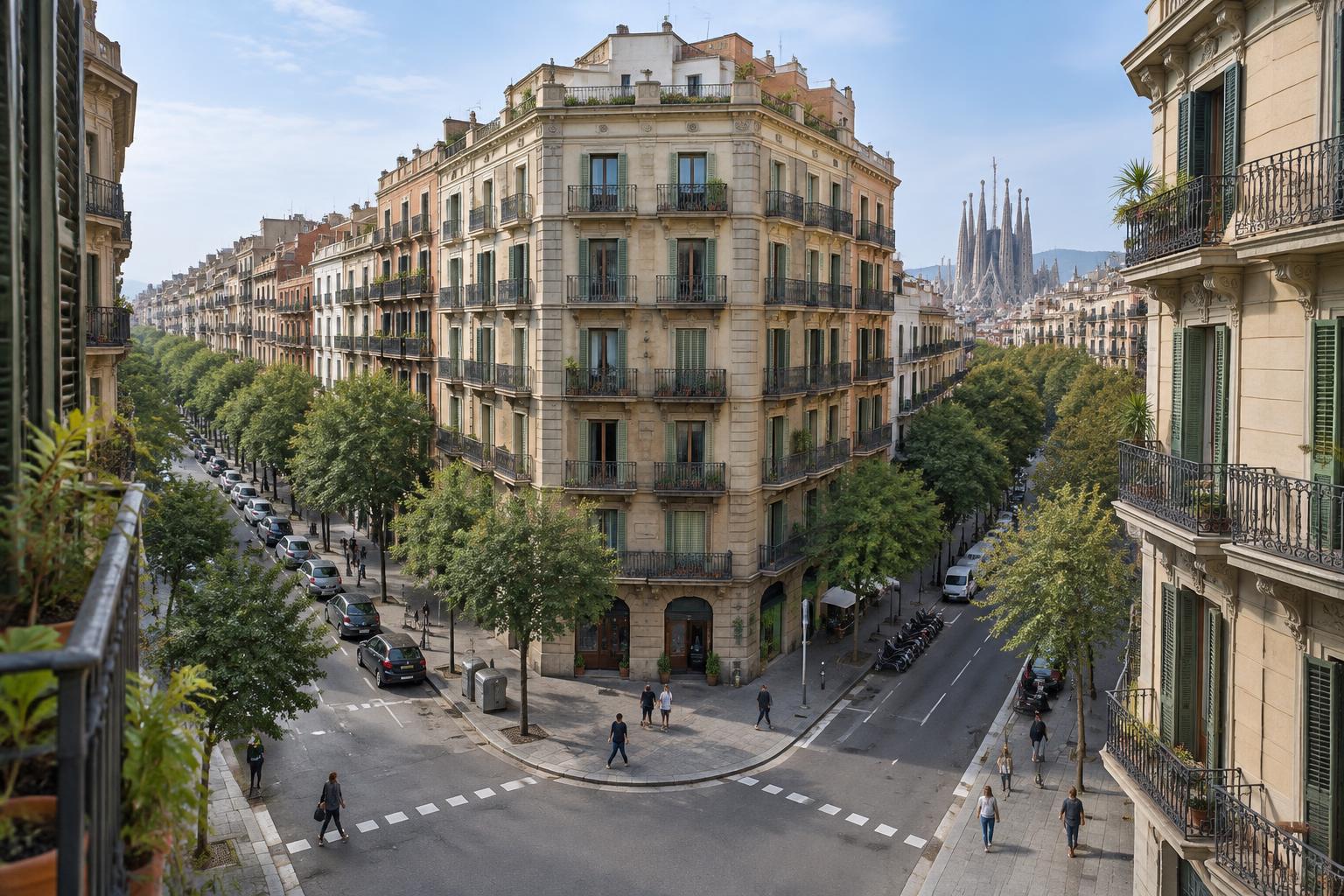
Why homes are hard to rent in Barcelona, what research says about tourist flats, and what the planned November 2028 licence phase-out means for owners.
Barcelona has not literally run out of homes, but finding a stable, affordable tenancy has become difficult for many households. Tourist apartments add pressure, particularly in heavily visited neighbourhoods. Blaming the entire crisis on Airbnb, however, mistakes one significant factor for the whole explanation. This investigation separates evidence from policy promises and explains the implications for owners, including people who are not tax-resident in Spain.
How renting became so difficult
Housing supply adjusts slowly; demand can grow or concentrate much faster. In an established city, additional homes require land, redevelopment, finance and time. Household formation, workers and students, incomes and insufficient affordable housing also matter. When a dwelling switches from a permanent tenancy to nightly accommodation, it no longer competes for a long-term tenant. That mechanism adds pressure without explaining the entire market.
Digital platforms made apartments easier to market to visitors and monetised tourist locations. Potential nightly revenue can encourage conversion, but gross revenue is not profit: occupancy, platform fees, cleaning, maintenance and tax all matter. Not every tourist flat previously housed a permanent tenant. Counting online listings alone cannot establish the net loss of residential rental homes; previous and subsequent uses must be tracked.
What the housing figures actually show
Generalitat figures put Barcelona’s average registered primary-home rent at €1,193.51 a month in Q1 2024, €1,160.99 in Q4 2025 and €1,137.35 in Q1 2026, a nominal 4.7% reduction over two years. This is not the asking price of every advertised home or the rent under every ongoing tenancy. A change in the mix of properties contracted can change the average. A before-and-after comparison alone does not establish the causal effect of rent regulation. [9]
Barcelona recorded 16,001 rental contracts in January–June 2026. That is a flow of transactions, not 16,001 available homes or the total rental stock. In 2025, 1,199 homes were started and 1,434 completed: gross additions, not necessarily affordable rentals. Registered average rents can fall while finding a suitable home remains difficult. [10][11]
Airbnb has an effect—but neighbourhoods differ
A 2020 Journal of Urban Economics study by García-López, Jofre-Monseny, Martínez-Mazza and Segú estimated that Airbnb activity increased rents by 1.9% in the average neighbourhood and about 7% in the highest-activity decile. Estimated transaction-price effects were 4.6% and 17%, respectively. The research uses several identification methods rather than simply correlating tourist growth with prices. [12]
These are estimates for the historical period studied, conditional on the analysis’s assumptions. They do not mean Airbnb explains 1.9% of all rent growth, nor predict an exact 7% rent fall in 2028. A municipal publication in 2026 places tourist flats at around 1.3% of the city’s housing stock: a small overall share can still have substantial local effects where concentrated. [2]
From freezing licences to planning a phase-out
- 2014: Barcelona stops new HUT licences, according to the municipal retrospective.
- 2017: the PEUAT introduces tourist-accommodation planning controls.
- 26 January 2022: the revised PEUAT, approved in December 2021, enters into force, with zero net HUT growth and conditional redistribution of existing capacity.
- 9 November 2023: Catalan Decree-law 3/2023 takes effect.
- 21 June 2024: the city announces the intended November 2028 end of authorisations for 10,101 tourist dwellings.
- 13 March 2025: the Constitutional Court rejects the challenge to the decree-law.
- February 2026: the city reaffirms the 2028 objective, rather than announcing completed closures.
The PEUAT covers several accommodation categories. Zero net growth does not mean all legal operations have stopped or every conditional movement of existing capacity is impossible. 10,101 is the count used in the 2024 announcement, not a live November 2026 register total. [1][2][3][6]
Catalan law and Barcelona’s choice are not identical
Decree-law 3/2023 initially covers 262 municipalities. It requires express compatibility in urban planning and a prior municipal planning licence, valid for five years and renewable. Its ceiling is 10 tourist dwellings per 100 inhabitants, not per 100 homes. Existing authorised activities have five years from entry into force to obtain the required licence or cease, giving the 9 November 2028 horizon. [4]
The transitional rules allow a possible individual, one-off extension of up to five additional years, subject to statutory requirements and justification. It is not automatic. Barcelona announced it would not adopt planning provisions maintaining tourist-use compatibility for these dwellings. Other affected municipalities may choose different solutions within the framework: this decree does not require every tourist flat across Catalonia or Spain to disappear.
Constitutional judgment 64/2025 upheld the challenged framework. It does not prejudge every subsequent municipal decision, extension application or claim, or guarantee identical outcomes in every individual case. [5]
Tourist, seasonal and permanent rentals are different
A tourist-use dwelling, or HUT, is a regulated accommodation category. Temporary tenancies may serve work, study or medical needs. An “11-month” duration or a platform listing does not alone determine the applicable regime. Relabelling a contract does not turn a permanent housing need into a legitimate tourist or temporary stay.
Catalan Law 11/2025, effective from 1 January 2026, includes rental-modality, inspection and housing measures. Separately, on 27 March 2026 Barcelona provisionally approved a planning amendment distinguishing permanent and temporary residential uses. The announcement required definitive Generalitat approval; a subsequent definitive approval has not been verified here. That announcement alone is not evidence of a fully effective seasonal-rental ban. [7][8]
Will 10,101 homes become affordable rentals?
That cannot be guaranteed. Recovering residential use can allow long-term letting, but owners may instead sell or occupy their homes. Evaluation must measure how many actually enter permanent rental, at what prices and in which neighbourhoods, alongside illegal activity and displacement into other uses. Licensing is one part of housing policy, not a substitute for construction, rehabilitation and affordable housing.
Checks for a non-resident owner
- Before buying, verify permitted planning use and the specific authorisation. A listing advertising a “tourist licence” does not guarantee indefinite operation or automatic transfer.
- Before changing rental type, check the contract, applicable law, owners’ association and local and regional requirements. A platform registration number does not replace a planning licence.
- Separate permission from tax: paying Modelo 210 does not legalise an unauthorised activity.
- Keep income, expenses, rental periods and days available to the owner. For non-resident individuals, rental income and potential imputed income for personal-use days receive different treatment.
- Check each co-owner’s return and ownership share. Tax residence, not nationality, determines the applicable rules.
SpainTaxForm can help with non-resident tax filing. Accommodation permission and planning advice must be checked separately; ending tourist letting does not necessarily remove the property’s tax obligations.
Frequently asked questions
Are all tourist flats already banned?
No. The municipal sources reviewed describe a transition towards November 2028. Authorised operations remain subject to current rules and conditions during that transition.
Does this affect hotels in the same way?
No. The 10,101-dwelling announcement concerns HUT, not the closure of every hotel or all tourist accommodation.
Will rents automatically fall in 2028?
No reduction is guaranteed. The outcome depends on actual conversion to permanent rental and wider supply and demand.
Research reviewed on 9 November 2026. References are linked in the text and listed below; some originals are in Catalan. General information, not an opinion on a specific licence or contract. A live HUT register and the resolution of all pending proceedings have not been verified.
Sources
- 1Barcelona — June 2024 announcement
- 2Barcelona Metròpolis — History of restrictions
- 3City council — Current PEUAT plan
- 4BOE — Catalan Decree-law 3/2023
- 5BOE — Constitutional judgment 64/2025
- 6Barcelona — February 2026 policy confirmation
- 7Generalitat — Housing Law 11/2025
- 8City council — Seasonal rentals, provisional approval
- 9Generalitat — Registered primary-home rents
- 10Generalitat — Contracts by neighbourhood and district
- 11Generalitat — Housing starts and completions
- 12García-López et al. — Airbnb study, 2020
Comments(0)
Sign in to leave a comment
Be the first to comment.