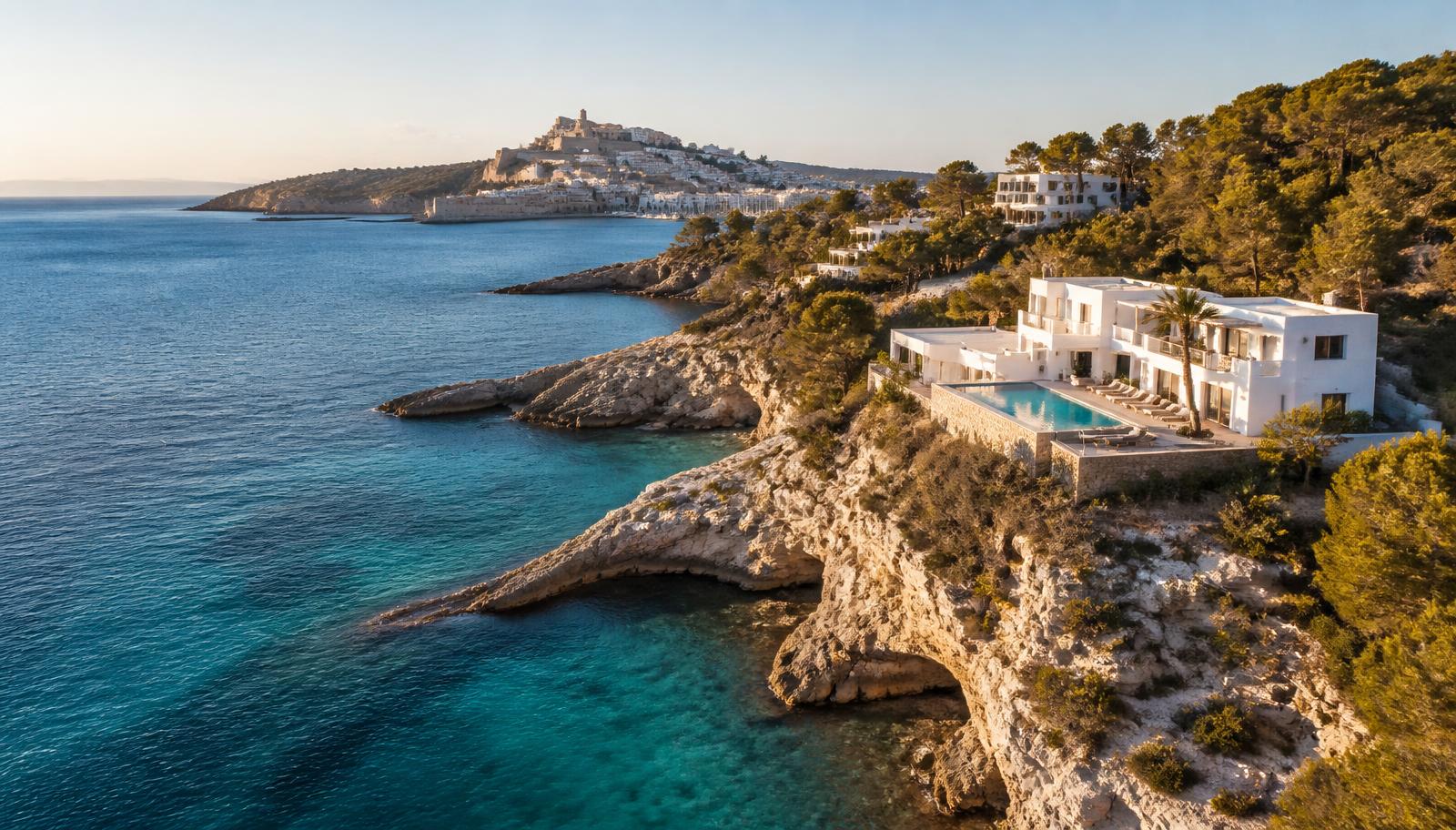
Discover Ibiza's tourism boom, record airport traffic, and rising property prices, including key insights into the Modelo 210 for non-resident homeowners.
Ibiza transformed from an agricultural and fishing island in the Balearic Islands, almost isolated until the 1960s, into one of the most visited and expensive destinations in the world. Its airport closed 2025 with more than 9 million passengers and its municipalities currently lead Spain's record housing prices. This guide reconstructs the island's evolution—tourism, airport, and real estate prices—and explains the taxes a non-resident owner who buys in Ibiza must pay in Spain.
1. The timeline: from forgotten island to global icon
- 1930s-1950s: isolation. Economy based on agriculture, fishing, salt from Ses Salines, and emigration. Tourism was almost non-existent and the connection with the mainland depended on boats.
- 1958: the civil airport. The opening of the Es Codolar airfield to civil traffic breaks the isolation. Ibiza begins to receive its first regular flights.
- 1960s: the counterculture. Artists, bohemians, and travelers from the hippie movement choose the island for its climate, low prices, and tolerance. The "Ibiza myth" is born: freedom, street markets, sunsets, and a cultural identity distinct from the mass tourism of the mainland coast.
- 1973-1980: clubbing is born. The opening of Pacha (1973) followed by Amnesia and Privilege turns nightlife into the island's economic engine. Ibiza ceases to be cheap.
- 1980s-1990s: global projection. British DJs vacationing on the island take the "Balearic beat" sound to London and Manchester. The island becomes the world capital of electronic music and multiplies its hotel capacity.
- 1999: UNESCO stamp. UNESCO declares the "Ibiza, biodiversity and culture" ensemble a World Heritage Site: the posidonia seagrass meadows, Dalt Vila, the Puig des Molins necropolis, and the Sa Caleta Phoenician settlement. Ibiza adds a heritage narrative to its party image.
- 2000-2010: the shift to luxury. Boutique hotels, agrotourism, restoration of country estates (fincas payesas), and the arrival of high-end villas. The high-net-worth foreign buyer replaces the low-budget tourist as the market driver.
- 2015-2026: scarcity and records. Limited land, urban planning moratoriums, limits on tourist beds, and growing international demand push prices to historic highs, with severe tension in the residential rental market.
2. Ibiza airport: growth and national position
Ibiza airport (IBZ) is the infrastructure that explains the scale of the phenomenon. In 2025 it exceeded 9 million passengers, 0.7% more than in 2024, according to traffic data published by Aena. With this figure, it ranks steadily among the seven or eight busiest airports in Spain (behind Madrid, Barcelona, Palma, Málaga, Alicante, Gran Canaria, and Tenerife Sur, depending on the year), and it is the airport with the highest seasonal concentration in the country: in July and August, it can move more than 1.5 million passengers per month.
Features that make it unique:
- Extreme seasonality. More than 80% of traffic is concentrated between May and October; in winter, activity drops to regional airport levels.
- British weight. The United Kingdom is the primary international market, followed by Italy, Germany, and the Netherlands.
- Very dense national routes. Barcelona, Madrid, and Palma are the three connections with the most annual passengers.
- Private aviation. Ibiza is one of the Spanish airfields with the highest volume of executive aviation in the summer, reflecting the profile of second-home buyers.
| Stage | Approximate passengers/year | Context |
|---|---|---|
| 1960s | Hundreds of thousands | First regular and charter flights |
| 1980s | ~2-3 million | Explosion of sun and club tourism |
| 2000s | ~4-5 million | Consolidation as a European destination |
| 2015-2019 | ~6.5-8 million | Low cost, new routes, and premium shift |
| 2020-2021 | Drastic drop | Pandemic and mobility restrictions |
| 2023-2025 | ~8.5-9 million | Full recovery and historic highs |
Figures by decades are orders of magnitude based on Aena's historical traffic series; the 2025 figure (over 9 million) is official.
3. Housing prices: why Ibiza is among the most expensive in Spain
Baleares is currently the most expensive province in Spain for buying second-hand housing. Price reports from idealista placed the provincial average price around 5,500 €/m² in 2025, with double-digit annual increases, and several municipalities in Ibiza at historic highs. The extreme case is Sant Joan de Labritja, which exceeded 8,900 €/m², the highest level among the locations that set records.
| Area | Estimated sales price (€/m²) | Profile |
|---|---|---|
| Sant Joan de Labritja | 8,000-9,000 | Rural north, exclusive estates and villas |
| Santa Eulària des Riu | 6,000-7,500 | International families, consolidated developments |
| Sant Josep de sa Talaia | 6,000-7,500 | Cala Comte, Es Cubells: luxury front line |
| Ibiza city (Eivissa) | 4,500-6,000 | Dalt Vila, Marina Botafoch, urban market |
| Sant Antoni de Portmany | 4,000-5,000 | British tourism, apartments, and renovations |
| Formentera (comparative) | 6,000-8,000 | Very limited supply, extremely exclusive |
2025-2026 market orientation ranges according to portals and notary statistics; the real price depends on quality, licenses, and proximity to the sea.
Approximate evolution of the average price on the island
| Year | Approximate €/m² | Accumulated variation |
|---|---|---|
| 2000 | ~1,500 | Base |
| 2007 (bubble peak) | ~3,000 | +100% |
| 2013 (minimum) | ~2,300 | +53% |
| 2019 | ~4,400 | +193% |
| 2025-2026 | ~5,500-6,000 | +270-300% |
Ibiza had two particularities compared to the rest of Spain: its correction after 2008 was softer and shorter, and its recovery started earlier, as early as 2013-2014, because demand is mostly international and not very dependent on Spanish mortgage credit.
4. Rentals: the most stressed market in the country
The combination of scarce land, tourist demand, and seasonal workforce has turned residential rentals into the island's main social problem:
- Long-term rentals usually range between 20 and 30 €/m² per month, with highs among the most expensive in Spain.
- During peak season, a villa with a tourist license can bill between 5,000 and 60,000 € per week depending on location, size, and services.
- The gross yield from buying to rent usually stays between 3% and 5%: the entry price is so high that it compresses returns, although historical capital gains have been the true attraction.
- Tourist rentals require a license and registration number from the Consell d'Eivissa; the number of beds is limited and penalties for illegal rentals are high.
5. What does the tourist look for in Ibiza that they can't find elsewhere?
- Concentration of world-class nightlife within a few kilometers, with DJ residencies that no other destination reproduces.
- Extreme contrast: on the same island, the rural and silent north coexists with the most intense leisure in the Mediterranean.
- Coves and transparent water protected by the posidonia meadows declared a World Heritage Site.
- Real heritage: walled Dalt Vila, the Punic necropolis, and the Phoenician site of Sa Caleta.
- European safety, healthcare, and connectivity, with direct flights from dozens of cities.
- Cultural brand built over 60 years, impossible for a new destination to replicate.
6. Taxation for non-resident owners in Ibiza
If you buy in Ibiza without being a tax resident in Spain, you pay Non-Resident Income Tax (IRNR) through Modelo 210:
| Situation | What is declared | Rate | Deadline |
|---|---|---|---|
| Own-use or empty housing | Imputed income (1.1% or 2% of cadastral value) | 19% EU/EEA · 24% rest | Until December 31 of the following year |
| Rentals | Income minus deductible expenses (only EU/EEA residents can deduct) | 19% EU/EEA · 24% rest | Annual tax return for the fiscal year |
| Sale | Capital gain | 19% | 4 months from the deed |
| Sale (buyer) | 3% withholding (Modelo 211) | 3% of the price | 1 month from the deed |
Additionally, you will pay the municipal IBI and waste collection fee annually, and upon purchase, the Balearic ITP, with a progressive scale that reaches the highest brackets in the country for high-value properties. Remember that if the property has several owners, each one submits their own Modelo 210 according to their ownership percentage.
7. Conclusion
Ibiza is not expensive by chance: it is the result of 60 years of brand building, an air infrastructure that moves more than 9 million passengers a year, and a structurally limited land supply. For the foreign investor, this means a scarce asset with historical appreciation well above the Spanish average, but also taxation and tourist rental regulations that should be planned before signing.
At SpainTaxForm, we prepare and submit your Modelo 210—imputed income, rentals, or capital gains—from 30 €, in your language and without a digital certificate.
Sources
- 1Aena — Nota de prensa: el aeropuerto de Ibiza supera los 9 millones de pasajeros en 2025
- 2Aena — Estadísticas de tráfico aéreo
- 3idealista — Informes de precio de la vivienda (Baleares e Ibiza)
- 4UNESCO — Ibiza, biodiversidad y cultura (Patrimonio de la Humanidad, 1999)
- 5Consejo General del Notariado — Compraventas por extranjeros
- 6AEAT — Modelo 210, IRNR
Comments(0)
Sign in to leave a comment
Be the first to comment.