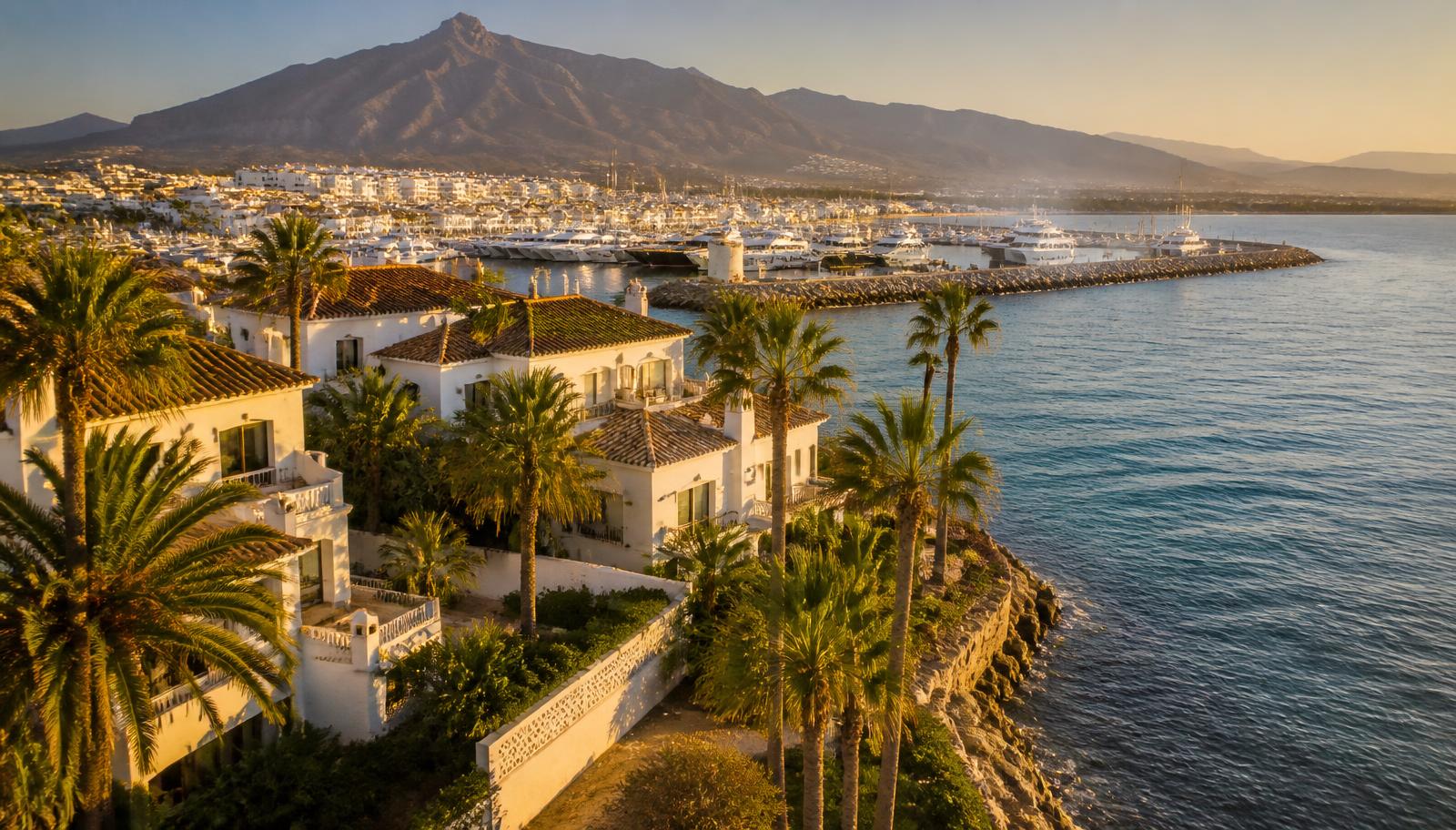
How Marbella went from under EUR 1,000/m2 to over EUR 5,000/m2. Sale and rental price evolution, micro-markets, international buyers and non-resident tax rules.
Marbella did not become the Mediterranean's luxury capital by accident. It took more than 70 years and three clear jumps: the arrival of European aristocracy in the 1950s-60s, the building of Puerto Banús in 1970 and, above all, the 2014-2026 cycle, when high-net-worth international buyers turned the municipality into a record-price market. This guide reconstructs 30 years of sale and rental price evolution, pinpoints when the decisive shift happened, analyses who today's main international buyers are, and explains what a non-resident owner actually pays in tax.
1. From coastal town to elite destination: the timeline
- 1940s-50s: the starting point. Marbella was a farming and fishing town of under 10,000 people. The Marbella Club, driven by Prince Alfonso von Hohenlohe from 1954, brought in European aristocracy and created the first international word of mouth.
- 1970: Puerto Banús. The marina developed by José Banús was the real accelerator, turning a stretch of coast into a showcase of yachts, luxury retail and high-end development.
- 1980s-90s: expansion and disorder. Rapid residential growth, golf courses in Nueva Andalucía and huge media exposure — but also decades of planning-law uncertainty (annulled master plans, contested licences) that kept institutional capital away.
- 2000-2007: the bubble. Cheap credit and speculative buying multiplied prices across the Costa del Sol.
- 2008-2013: the correction. Demand collapsed and prices adjusted — but Marbella fell less than the Spanish average because its demand is international and far less mortgage-dependent.
- 2014-2019: selective recovery. Foreign buyers returned, legal certainty improved and the product repositioned towards contemporary villas and premium new build.
- 2021-2026: the big leap. Remote work, the search for a second home with climate, land scarcity and massive international capital inflow. This is when Marbella moved from "expensive" to a fully consolidated luxury market.
2. Sale price evolution (€/m²)
The series blends asking prices (idealista), valuations (Tinsa IMIE, Sociedad de Tasación) and notarial/registry data. Pre-2000 figures are estimates from Costa del Sol historical series; from 2005 onwards the data comes from published sources.
| Year | Marbella (€/m²) | Context |
|---|---|---|
| 1996 (est.) | ≈ 700-900 | Local market, abundant supply |
| 2000 (est.) | ≈ 1,300-1,500 | Start of the expansion cycle |
| 2007 | ≈ 3,200-3,400 | Bubble peak |
| 2013 | ≈ 2,000-2,200 | Cycle floor (-35 % from 2007) |
| 2019 | ≈ 2,900-3,100 | Pre-pandemic recovery |
| 2024 | ≈ 4,700 | 2007 nominal peak exceeded |
| May 2025 | 5,162 | All-time asking-price high (idealista), +9.8 % YoY |
| Q1 2026 | 4,500-4,900 | Tinsa IMIE ≈ €4,847/m²; average deed price ≈ €4,582/m² |
Two key readings: (1) over 30 years prices have multiplied roughly 5-6 times in nominal terms; (2) asking prices always run ahead of actual deed prices, and that gap widens in luxury markets.
Micro-markets: luxury is not uniform
| Area | €/m² (2025) | YoY change |
|---|---|---|
| Nagüeles — Golden Mile | 6,422 | +4.6 % |
| Nueva Andalucía | 5,578 | +6.1 % |
| Las Chapas — El Rosario | 5,410 | +14.1 % |
| San Pedro de Alcántara | 4,502 | +13.9 % |
| Marbella old town | 4,390 | +9.0 % |
| Elviria — Cabopino | 4,375 | +22.4 % |
The 2025-2026 pattern is clear: the Golden Mile rises slowly because it is already at the ceiling with very thin supply, while entry areas (Elviria, Las Chapas, San Pedro) grow at double digits. Classic spillover in a mature luxury market.
3. New build: the segment that broke every ceiling
According to Savills analysis for the Costa del Sol, in 2025 the average new-build apartment price rose 23 % to €5,725/m², breaking the €1 million per unit barrier for the first time (≈ €1,016,600). New villas and detached homes averaged €6,379/m² (≈ €2.97M per unit). New build keeps a 12-18 % premium over equivalent resale.
4. Rentals: structural scarcity
Marbella's rental market has changed in nature. A large share of the housing stock has shifted to short-term holiday letting, with higher gross yields, while many non-resident owners keep the property for personal use. The result: a very thin long-term supply against rising international demand (executives, families in international schools, high-end digital nomads).
- Long-term: annual contracts are increasingly scarce, with rent increases well above inflation across Málaga province.
- High season (June-September): where holiday-let income concentrates; a Golden Mile villa can bill in three months what a long-let flat bills in a year.
- Regulation: holiday letting in Andalucía requires registration in the Registro de Turismo de Andalucía (RTA) and, since 2025, in the national single register for short-term rentals.
For non-resident owners this has a direct tax consequence: every period with a tenant produces rental income and every period without one produces imputed income. Both are declared on Modelo 210.
5. When did the most important change happen?
If you must pick one turning point, it is neither 2007 nor 2013: it is 2021-2022, where four irreversible factors converge:
- Buyer profile shift: from speculative investor to wealth-preservation cash buyer seeking lifestyle.
- Scarcity of developable land on the front line and the Golden Mile: supply can no longer answer demand.
- Capital internationalisation: new flows from the US, the Middle East, Poland and Scandinavia on top of the classic markets.
- Product repositioning: contemporary villas, branded residences and hotel-grade services attached to housing.
The full stop on the speculative cycle was the abolition of the Golden Visa (Organic Law 1/2025, effective 3 April 2025): the market kept rising without a residency-by-investment incentive, proving the demand is real rather than tax-driven.
6. The main international buyers
Across Andalucía roughly 35 % of notarised purchases are made by foreign nationals; in Marbella the share is far higher — market reports put the foreign-buyer share between 41 % and 61 % depending on quarter and segment. Dominant profiles:
| Origin | Preferred area | Profile |
|---|---|---|
| United Kingdom | Golden Mile, Elviria, San Pedro | Second home and retirement; the historic market |
| Netherlands & Belgium | Nueva Andalucía, Estepona | Families, mixed own-use plus letting |
| Germany & Austria | Benahavís, Sierra Blanca | Contemporary new build, energy efficiency |
| Scandinavia (SE, NO, DK) | Nueva Andalucía, Los Monteros | Established community, international schools |
| United States | Golden Mile, Marbella East | Fastest-growing cohort; high average ticket |
| Poland & Eastern Europe | Estepona, Nueva Andalucía | Recent entry, at scale |
| Middle East | La Zagaleta, Sierra Blanca, Camoján | Highest ticket in the market |
7. Non-resident taxation in Marbella
Buying in Marbella does not change IRNR rules, but it does raise the numbers. Operational summary:
- Imputed income (property at your disposal): base of 1.1 % or 2 % of the cadastral value, taxed at 19 % (EU/EEA) or 24 % (rest, including the UK and the US). One Modelo 210 per owner per year.
- Rental: EU/EEA residents pay 19 % with deductible expenses; everyone else pays 24 % on gross income, no deductions.
- Sale: capital gain at 19 % plus a 3 % withholding retained by the buyer (Modelo 211), reclaimable via Modelo 210 if the final tax is lower.
- Transfer tax in Andalucía: general rate 7 % on resale; new build carries 10 % VAT plus stamp duty.
- IBI and waste charges: municipal, and they do not replace Modelo 210 — they are different taxes.
- Joint ownership: each owner files their own Modelo 210 for their ownership share, even a 50/50 married couple.
With SpainTaxForm you file Modelo 210 from €30 per owner per year for imputed income, with dedicated services for rentals, capital gains and 3 % withholding refunds.
8. Conclusions
- Marbella took 70 years to build its luxury brand, but the decisive price jump is concentrated in the last five years.
- Average prices went from under €1,000/m² in the mid-1990s to above €5,000/m² in 2025.
- Supply scarcity — for sale and for rent — is the structural price driver, not credit.
- The buyer is international, mostly cash, and increasingly diversified by nationality.
- Every non-resident owner of a Marbella property has an annual Modelo 210 obligation, whether they rent it out or not.
Sources
Comments(0)
Sign in to leave a comment
Be the first to comment.