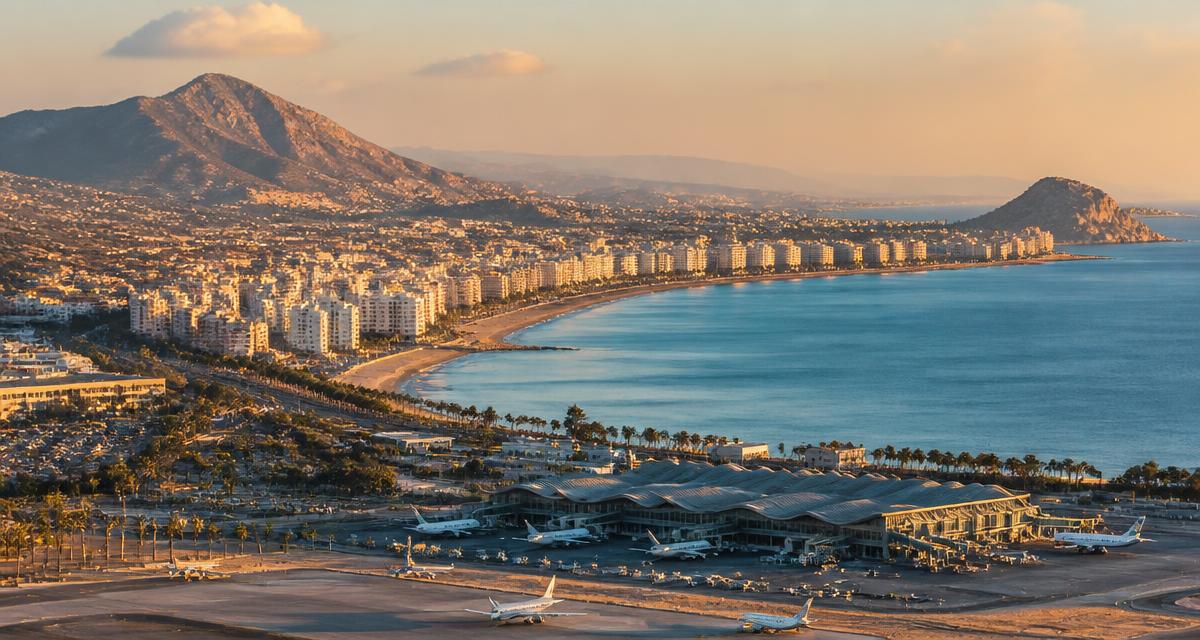
How Alicante-Elche airport grew from 1967 to 19.95 million passengers, and why the province leads foreign home purchases in Spain.
Few Spanish provinces illustrate the link between air connectivity and foreign property investment as clearly as Alicante. In 2025 Alicante-Elche Miguel Hernández Airport closed the year with 19,950,394 passengers (+8.5%), its third consecutive annual record, while the province led foreign home buying in Spain with 43.29% of all transactions. These are not two separate facts — they are the same story told from two angles.
From Lucentum to the Costa Blanca: a short history of the province
Alicante grew as a Mediterranean trading port (Roman Lucentum, Andalusi Al-Laqant) and for centuries lived on irrigated agriculture, Torrevieja salt, footwear from Elche and Elda, toys from Ibi and nougat from Jijona. The turning point came in the mid-20th century: the Costa Blanca brand was popularised in the British market in 1957, and in the 1960s Benidorm approved a pioneering urban plan built around high-rise density and year-round mass tourism.
What followed is well known: residential estates in Torrevieja and the Vega Baja in the 1970s and 1980s, mass arrival of British, German, Dutch and Nordic retirees in the 1990s, the 1998-2007 property boom, the 2008-2013 crash and oversupply, recovery from 2014, and a post-pandemic cycle driven by remote work, second homes and European retirement.
The airport: 1967-2026, from airfield to Spain's fifth busiest
El Altet airport opened in 1967, replacing the old Rabasa airfield. The milestones that followed track the province's own pulse: charter growth in the 1970s, European air transport liberalisation in the 1990s, the arrival of low-cost carriers (Ryanair, easyJet, Jet2, Norwegian, Transavia) from 2000, and the opening of the New Terminal Area (NAT) in 2011, which lifted capacity and enabled the jump from 10 to 20 million passengers in fifteen years.
| Year | Passengers | Milestone |
|---|---|---|
| 1967 | — | El Altet airport opens |
| 1990 | ≈ 3.0 M | British charter traffic consolidates |
| 2000 | ≈ 6.8 M | Low-cost carriers arrive |
| 2010 | ≈ 9.4 M | Before the new terminal |
| 2011 | ≈ 9.9 M | New Terminal Area (NAT) opens |
| 2019 | ≈ 15.0 M | Pre-pandemic record |
| 2020 | ≈ 3.7 M | COVID-19 collapse |
| 2023 | ≈ 15.7 M | 2019 levels exceeded |
| 2024 | 18.4 M | All-time record |
| 2025 | 19,950,394 | Third record in a row (+8.5%) |
Source: Aena traffic statistics and press release of 13 January 2026 [1][2].
Where does Alicante airport rank nationally?
Based on official Aena 2025 data, Alicante-Elche is Spain's fifth busiest airport by passengers, behind only Madrid, Barcelona, Palma de Mallorca and Málaga, and ahead of Gran Canaria, Tenerife South and Valencia.
| Rank | Airport | Passengers 2025 | Change |
|---|---|---|---|
| 1 | Adolfo Suárez Madrid-Barajas | 68,179,054 | +3.0% |
| 2 | Josep Tarradellas Barcelona-El Prat | 57,483,036 | +4.4% |
| 3 | Palma de Mallorca | 33,806,427 | +1.5% |
| 4 | Málaga-Costa del Sol | 26,760,549 | +7.4% |
| 5 | Alicante-Elche Miguel Hernández | 19,950,394 | +8.5% |
| 6 | Gran Canaria | 15,826,553 | +4.0% |
| 7 | Tenerife South | 13,969,678 | +1.7% |
| 8 | Valencia | 11,847,527 | +9.6% |
Source: Aena 2025 traffic data [1].
Other 2025 figures for Alicante-Elche: 126,081 aircraft movements (+8.4%, sixth nationally), 228 routes operated and 88% international traffic (17,458,244 passengers, +10.6%). The United Kingdom alone accounted for 6,553,349 passengers — almost one in three people passing through the terminal [1][2][3].
Why the airport shaped the second-home map
- Frequency and price. With more than 220 routes and heavy low-cost presence, a northern European owner can fly to their Spanish home for less than a domestic weekend costs.
- Deseasonalisation. A mild climate and 300+ days of sun sustain winter schedules, turning a holiday home into a six-month or year-round residence.
- Natural markets. The UK, Netherlands, Germany, Norway, Belgium, Sweden, Poland and Ireland all have frequent direct links — exactly the nationalities that dominate Costa Blanca purchases.
- Short distances. The airport sits 9 km from Alicante, 20 minutes from Elche, 45 from Benidorm and under an hour from Torrevieja, Jávea or Calpe.
- Network effect. More passengers mean more holiday rental demand, more English- and German-speaking services, and more international professionals — a loop that supports property values.
Foreign investment: Alicante is the national leader
According to the Association of Property Registrars, foreigners were involved in nearly 97,500 purchases in Spain in 2025 (13.8% of the total, an absolute volume record). By province, Alicante tops the ranking with 43.29% of transactions, well ahead of Málaga (32.80%), Santa Cruz de Tenerife (30.04%), the Balearics (29.86%), Girona (25%), Las Palmas (21.72%) and Murcia (21.42%) [4][5].
| Province | Share bought by foreigners (2025) |
|---|---|
| Alicante | 43.29% |
| Málaga | 32.80% |
| Santa Cruz de Tenerife | 30.04% |
| Balearic Islands | 29.86% |
| Girona | 25.00% |
| Las Palmas | 21.72% |
| Murcia | 21.42% |
| National average | 13.80% |
Source: Registrars' 2025 yearbook, reported by idealista [4][5].
The internal split follows geography: the southern Costa Blanca (Torrevieja, Orihuela Costa, Guardamar, Pilar de la Horadada) is dominated by British, German, Belgian, Polish and Scandinavian buyers; the northern Costa Blanca (Jávea, Moraira, Altea, Calpe, Benissa, Dénia) attracts higher-budget Dutch, German, French and British purchasers. In Q4 2025 alone, 5,672 foreign purchases were registered in the province versus 2,831 in Málaga [6].
Price evolution across the province (indicative)
| Area | €/m² ≈ 2015 | €/m² ≈ 2025 | Change |
|---|---|---|---|
| Jávea / Xàbia | ≈ 1,750 | ≈ 3,300 | +88% |
| Moraira-Teulada | ≈ 1,700 | ≈ 3,200 | +88% |
| Altea | ≈ 1,600 | ≈ 2,900 | +81% |
| Calpe | ≈ 1,500 | ≈ 2,700 | +80% |
| Dénia | ≈ 1,450 | ≈ 2,600 | +79% |
| Benidorm | ≈ 1,500 | ≈ 2,600 | +73% |
| Alicante city | ≈ 1,250 | ≈ 2,400 | +92% |
| Orihuela Costa | ≈ 1,150 | ≈ 2,100 | +83% |
| Torrevieja | ≈ 1,000 | ≈ 1,900 | +90% |
| Inland (Elda, Villena, Alcoy) | ≈ 700 | ≈ 1,000 | +43% |
Indicative asking-price values drawn from public idealista series and registry statistics; useful for comparing trends, not as a valuation [4][7].
The conclusion is clear: coastal areas served by direct flights have appreciated far faster than the province's interior, and the gap has widened since 2021.
Tax implications of buying in Alicante as a non-resident
As a non-resident owner you must file Modelo 210 with the Spanish Tax Agency every year:
- Own use or empty property: taxed on imputed income (1.1% or 2% of the cadastral value) at 19% (EU/EEA) or 24% (rest of the world).
- Rented property: declare your rental income; EU/EEA residents may deduct expenses and pay 19%.
- Sale:capital gains at 19% plus the 3% withholding (Modelo 211) paid by the buyer; if you sold at a loss you can claim the withholding refund.
- IBI: an annual municipal tax, separate from and compatible with Modelo 210 (no double taxation — they tax different things).
Where there are several owners, each one files their own Modelo 210 for their ownership share.
Outlook: 20 million and expansion
Alicante-Elche fell fewer than 50,000 passengers short of the symbolic 20-million mark, and Aena has placed it among the priority infrastructures in its investment plan, with works planned for the terminal, apron and access roads [1][2]. If the trend holds, the province will gain more routes, a longer season and steadier housing demand. For foreign owners that means two things: appreciation, and annual tax obligations worth keeping in perfect order.
Sources
Comments(0)
Sign in to leave a comment
Be the first to comment.