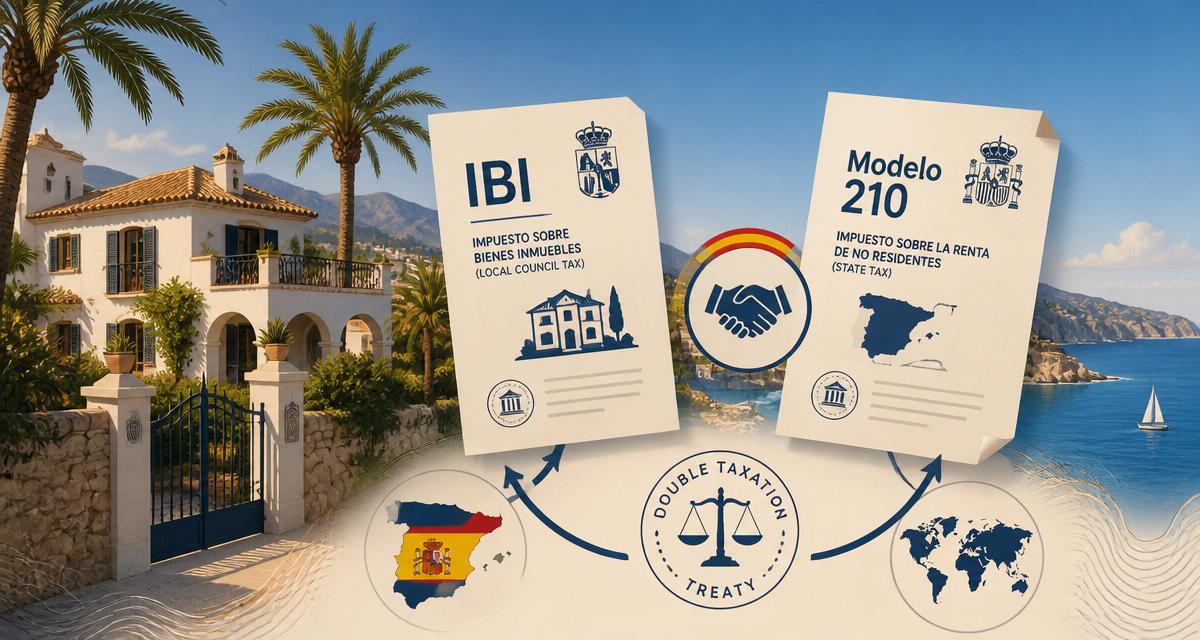
In-depth study of Spain's IBI (local property tax) and Modelo 210 (Non-Resident Income Tax): what they are, how they differ, why IBI is paid once per property while Modelo 210 is paid by each owner, how double taxation works with treaty countries, and what happens when the owner is a non-resident company.
One of the most common mistakes non-resident property owners in Spain make is confusing the IBI with the Modelo 210. They are two different taxes, from two different administrations, with different taxable events and radically different rules. This long, detailed guide explains what each one is, how they interact, how double taxation is neutralised under Spain's tax treaties (CDI), and what happens when the owner is not an individual but a non-resident company.
1. What is IBI (Impuesto sobre Bienes Inmuebles)?
IBI is a local, municipal, in rem, objective tax regulated in articles 60-77 of Royal Legislative Decree 2/2004 (Local Finance Act). It is collected by the town hall where the property is located.
- Taxable event: holding a real right (ownership, usufruct, surface right, administrative concession) over an urban, rural or special-features property.
- Tax base: the cadastral value set by the Spanish Cadastre.
- Tax rate: set by each town hall within legal limits (0.4%–1.10% on urban property, with possible surcharges).
- Accrual date:1 January each year. Whoever owns on that day pays IBI for the whole year, even if they sell the next day.
- Payment window: set by the town hall, typically May–November.
IBI is paid ONCE per property, regardless of the number of owners
This is a critical point where confusion is highest. IBI is levied on the property, not on the owner. Whether a property has one, two, five or ten co-owners, the town hall issues a single bill for the full cadastral value. Co-owners are jointly and severally liable to the town hall (art. 64 TRLHL) and then split the cost internally according to their ownership share.
Example: A British couple owns 50/50 a villa in Marbella with an annual IBI of €1,200. Marbella town hall issues one single bill of €1,200. Both are jointly liable. Internally each pays €600, but for the town hall there is only one bill.
2. What is Modelo 210 (Non-Resident Income Tax)?
Modelo 210 is the official form to self-assess the Non-Resident Income Tax (IRNR), regulated by Royal Legislative Decree 5/2004. It is collected by the Spanish Tax Agency (AEAT), i.e. the central State, not the town hall.
- Taxable event: obtaining Spanish-source income by non-resident individuals or entities (e.g. holding an urban property — imputed income, rental income, or capital gain on sale).
- Taxpayer: each non-resident owner personally, for their ownership share.
- Rate:19% for EU/EEA residents (expenses deductible), 24% for residents outside EU/EEA (no deductions).
- Deadlines: imputed income — by 31 December of the following year; rentals — annual (1–20 April, July, October, January); capital gains — within 4 months of the sale deed.
Modelo 210 is filed BY EACH non-resident owner
Unlike IBI, this tax is personal. The AEAT treats every co-owner as a separate taxpayer. If a property is owned by two non-residents 50/50, two Modelo 210 forms are filed — one per person — with half of the taxable base attributed to each.
Example (imputed income 2026): A German couple owns 50/50 a Denia apartment with a revised cadastral value of €100,000. The annual base is 1.1% × €100,000 = €1,100. Two owners means:
- Owner A (German, EU): files Modelo 210 with base €550, tax at 19% = €104.50.
- Owner B (German, EU): files Modelo 210 with base €550, tax at 19% = €104.50.
- Total paid to the State: €209, split into two separate self-assessments.
Trying to file one single joint Modelo 210 for multiple owners is a very common mistake and the AEAT does not allow it (except in tight cases of aggregation for rentals with the same payer and period, and even then subject to strict rules).
3. Key differences between IBI and Modelo 210
| Aspect | IBI | Modelo 210 (IRNR) |
|---|---|---|
| Administration | Town hall | Spanish Tax Agency (State) |
| Nature | Local, in rem, objective tax | Central, direct, personal tax |
| Taxable event | Owning the property | Earning Spanish-source income |
| Tax base | Cadastral value | Imputed income, rent or capital gain |
| Rate | 0.4%–1.10% (municipal) | 19% EU/EEA — 24% rest |
| Bills per property | One only, no matter how many owners | One per non-resident owner |
| Liability | Joint and several among co-owners | Individual for each owner |
| Accrual | 1 January | Depends on type of income |
| Deductible on Modelo 210 | Yes, on rentals if EU/EEA resident | — |
4. Why pay both? Isn't this internal double taxation?
No. The Spanish system considers that IBI and Modelo 210 tax different events: IBI taxes ownership of the property (a local wealth-type tax); IRNR taxes the income that property produces or is deemed to produce (imputed income). Spanish case law and the General Directorate of Taxes (DGT) rulings confirm this repeatedly.
Good news: on rentals, if the owner is EU/EEA-resident and files Modelo 210 annual on rental income, they may deduct the IBI proportionally to the days let (art. 24.6 TRLIRNR). One of the most-overlooked deductions with real cash impact.
5. International double taxation: the treaties (CDI)
Enter the second layer: international double taxation. A non-resident owner may be taxed twice on the same income — once in Spain (source) and once in the country of residence. Spain has over 100 double taxation treaties (CDI), following the OECD Model.
General rule — OECD Model Article 6
Income from immovable property (rentals and capital gains from sale) may be taxed in the State where the property is located. Spain always keeps the right to tax the Spanish property. The country of residence must then apply a mechanism to eliminate double taxation.
Two typical mechanisms
- Exemption with progression: the residence country exempts the Spanish income but takes it into account to set the rate applied to the rest of the taxpayer's income. Common in Germany for rentals.
- Ordinary credit method (Foreign Tax Credit): the residence country taxes the Spanish income but credits the tax already paid in Spain up to the equivalent domestic tax on that income. Used by the UK, France, Netherlands, US, Italy, Belgium, and others.
Can IBI be credited in the residence country?
IBI, as a local wealth-type tax on property, is normally not covered by the CDI (which deals with taxes on income and sometimes on capital). In practice, many residence countries:
- Allow the IBI as a deductible expense when the owner declares rentals at home (e.g. UK Self Assessment treats IBI as council-tax-like expense).
- Do not accept it as a direct credit against the resident's income tax.
Rule of thumb: always keep the IBI receipt and ask a local advisor whether your country accepts it as a deductible expense.
Full worked example (British owner, rental income)
- Rent received 2026: €12,000
- Deductible costs (community fees, insurance, depreciation, IBI proportion): €4,000
- Since British, non-EU/EEA post-Brexit, rate is 24% with no deductions.
- Spanish tax (Modelo 210): 12,000 × 24% = €2,880.
- In the UK, HMRC taxes the rental again on the Self Assessment, allowing the €2,880 as Foreign Tax Credit Relief (capped at UK tax on that income).
Brexit tip: British owners are the worst-hit case since 2021 — they lost the 19% rate and expense deductions on Modelo 210. Real relief now comes back only via FTC at home.
6. Company (legal entity) non-resident owners
When the owner is not an individual but a non-resident company (e.g. a UK Limited, a German GmbH or a French SCI), several rules change.
a) IBI: exactly the same
IBI does not distinguish individuals from entities. The corporate owner receives one bill per property from the town hall. If several companies co-own, all are jointly liable.
b) IRNR (Modelo 210) for non-resident companies without a permanent establishment
A non-resident company without PE pays Modelo 210 at 24% (or 19% if EU/EEA with information exchange), same as a non-EU individual, but without personal allowances or internal double-taxation reliefs. It must file:
- Modelo 210 on imputed income (1.1% or 2% of cadastral value if the property is not economic-activity-affected and not let).
- Annual Modelo 210 on rentals.
- Modelo 210 on the capital gain on sale, with the 3% buyer withholding (Modelo 211) credited.
c) Special tax on Spanish real estate of non-resident entities (GEBI, Modelo 213)
Article 40 TRLIRNR sets a special annual tax of 3% on cadastral value for entities resident in a jurisdiction classified as a tax haven which own Spanish real estate. It is an anti-avoidance measure to prevent opaque structuring through low-tax jurisdictions with no CDI or no effective information exchange. Entities resident in a country with a CDI including an information-exchange clause are usually exempt, but must file Modelo 213 to declare or evidence the exemption.
d) Permanent establishment (PE)
If the Spanish real estate activity is structured enough (office, staff, active management) it may create a permanent establishment. In that case Modelo 210 is not used — instead Modelo 200 (Corporate Tax) applies at the standard 25% rate, with Spanish accounting rules. Less common for individuals and small SCIs, very relevant for foreign developers.
e) Companies with several non-resident shareholders
Modelo 210 is filed by the company (with its Spanish NIF), not by each shareholder. Shareholders will then be taxed in their country of residence on dividends or profit allocations, applying the relevant CDI.
7. Combined worked examples
Case 1 — French couple, empty holiday home in Valencia, cadastral value €90,000
- IBI 2026: 1 bill of €720 from the town hall. Co-owners jointly liable.
- Modelo 210 imputed income 2026: base 1.1% × €90,000 = €990. Each declares €495 at 19% = €94.05 each. Total to State: €188.10.
- In France: exemption with progression (art. 24 France-Spain CDI); property reported to set the marginal rate.
Case 2 — Dutch individual renting a Barcelona flat
- 2026 rent: €18,000. Deductibles (community, IBI, insurance, depreciation): €6,500.
- Annual Modelo 210: net base €11,500 at 19% = €2,185/year, paid in 4 filings.
- In the Netherlands: Box 3 on wealth; Spanish tax credited up to the Dutch cap.
Case 3 — UK Limited owning an Ibiza villa
- IBI: one bill in the company's name.
- Modelo 210 imputed income at 24% on 1.1% of cadastral value.
- Modelo 213 (GEBI): typically exempt under UK-Spain CDI's information-exchange clause, but filed to evidence the exemption.
- In the UK: the Ltd is taxed under worldwide Corporation Tax; Spanish tax credited as Double Taxation Relief.
8. Most common mistakes
- Thinking "I already paid IBI, no need for Modelo 210". Wrong: different taxes, different administrations.
- Filing one joint Modelo 210 for several owners. Wrong: one per owner, save for very narrow exceptions.
- Not deducting IBI on rentals when EU/EEA-resident. Frequently forgotten.
- Assuming a non-resident company need not file Modelo 213. It may be exempt but often still needs to file to evidence exemption.
- Ignoring the CDI: paying 24% in Spain and failing to claim Foreign Tax Credit at home.
9. Bottom line
- IBI goes to the town hall, one bill per property, regardless of owner count.
- Modelo 210 goes to the State, one per non-resident owner, on their share and income type.
- Both coexist and it is not internal double taxation — different taxable events.
- International double taxation is fixed by the CDI (exemption or foreign tax credit).
- Company owners must weigh Modelo 213 (GEBI) and possible permanent establishment.
10. References
- Royal Legislative Decree 5/2004, IRNR (arts. 12, 13, 24, 25, 40).
- Royal Legislative Decree 2/2004, Local Finance Act (arts. 60-77).
- Law 27/2014, Corporate Income Tax (permanent establishments).
- OECD Model Tax Convention (arts. 6, 13, 22, 23A/23B).
- Bilateral treaties between Spain and UK, Germany, France, Netherlands, Italy, US, etc.
- DGT binding rulings on IBI deductibility under IRNR.
Related guides
Sources
- 1Agencia Tributaria (AEAT) — Modelo 210 IRNR
- 2Ley del Impuesto sobre la Renta de No Residentes (RDL 5/2004)
- 3Ley Reguladora de las Haciendas Locales (RDL 2/2004) — IBI
- 4Ministerio de Hacienda — Convenios para evitar la Doble Imposición (CDI)
- 5Modelo OCDE de Convenio Tributario sobre la Renta y el Patrimonio
- 6Dirección General del Catastro — valores catastrales
- 7Ley 27/2014 del Impuesto sobre Sociedades (para EP y entidades no residentes)
Comments(0)
Sign in to leave a comment
Be the first to comment.