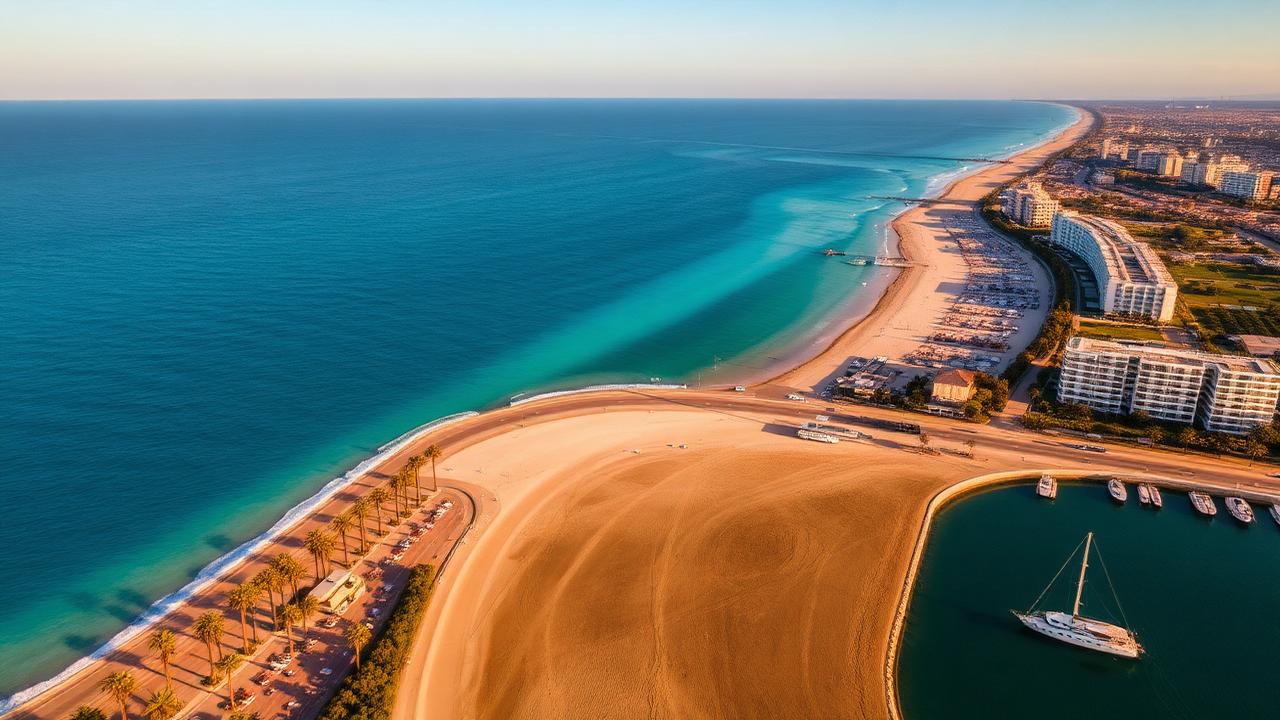
Official data from INE, Turespaña, AENA, Notariado and Land Registrars: Alicante has more than tripled foreign purchases and set tourism records. We analyse the 8 structural causes behind the phenomenon.
In two decades, Alicante province has gone from a well-established holiday destination to Spain's main property market for foreign buyers and one of Europe's fastest-growing tourism hubs. It is no accident: climate, air connectivity, relative prices, legal security and, since 2020, remote work and the digital nomad visa all play a part.
The numbers: what changed in 20 years
According to the Spanish Notarial Statistics Centre, foreign residential purchases in Alicante province rose from around 9,000 transactions a year in the mid-2000s to 30,290 in 2024, growth of +254% since 2010 [1][2]. Today, almost 1 in every 2 homes sold in the province is bought by a foreigner — Spain's highest share, ahead of Málaga and the Balearics [3].
On tourism, the Costa Blanca Tourism Board and Turespaña confirm Alicante closed 2024 with record figures: over 17 million overnight stays and foreign tourist spending above €10 billion a year in the Valencia Region, with the Costa Blanca as the main driver [4][5]. Alicante-Elche Miguel Hernández Airport exceeded 18.3 million passengers in 2024, versus 9.2 million in 2005 — virtually double in 20 years [6].
| Indicator | 2005 | 2024 |
|---|---|---|
| Alicante-Elche airport passengers | 9,2 M | 18,3 M |
| Foreign residential purchases (province) | ≈ 9.000 | 30.290 |
| % foreigners of total purchases | ≈ 20% | ≈ 47% |
| Hotel overnight stays (prov.) | ≈ 11 M | 17 M+ |
Sources: AENA, Notariado, INE Hotel Occupancy Survey [1][6][7].
The 8 causes behind the phenomenon
1. Climate and quality of life
Alicante averages 2,953 hours of sunshine a year and mild winters (January average ≈ 12 °C), one of Europe's best microclimates according to AEMET [8]. British, German, Dutch and Nordic buyers rank it as the number-one factor in Land Registrars surveys [3].
2. Still competitive relative pricing
Despite price rises, Alicante's average home price (€1,778/m² in 2024 per Tinsa) remains 35-45% below the Balearics or Costa del Sol, and well under southern France, Italy or the Côte d'Azur [9]. For Dutch, German or British buyers, the value proposition is unbeatable.
3. Air connectivity: the airport effect
Alicante-Elche Airport connects to more than 90 direct destinations in 30 countries, with daily flights to London, Manchester, Amsterdam, Brussels, Düsseldorf, Oslo, Stockholm, Warsaw and Dublin [6]. This enables the "second home within 3 hours" model that has fuelled Dutch and Belgian demand.
4. Brexit (2016-2020) and European diversification
Brexit temporarily reduced the British share but opened space for new European profiles. Today, per Notariado data, the Netherlands rivals the UK for top spot, with strong growth from Belgians, Poles and French buyers [2][10].
5. COVID-19 pandemic and remote work (2020-2022)
Lockdowns accelerated demand for homes with light, a terrace and proximity to the sea. CaixaBank Research documents that post-COVID foreign demand concentrated in Mediterranean provinces with good digital connectivity, with Alicante the biggest winner [11].
6. Startup Act and digital nomad visa (2023)
The Startup Act (Law 28/2022) introduced the digital nomad visa and a special tax regime (similar to the Beckham Law) for non-EU remote workers, taxed at 24% up to €600,000 for 6 years [12]. Alicante, Valencia and Málaga are the three provinces receiving the most applications.
7. Legal security and infrastructure for non-residents
Modelo 210, double-tax treaties with most of Europe, the AP-7 motorway, the Madrid-Alicante AVE (2h 20min) and public and private healthcare have created a legal and operational environment that is exceptional for a non-resident.
8. Diversity of housing product
From villas in Jávea, Moraira and Altea to new-build in Orihuela Costa, Pilar de la Horadada or Finestrat, plus urban apartments in Alicante city and Benidorm, the province offers every price range and style. PROVIA, the developers' association, notes that over 60% of new-build in the province sells to foreigners [13].
Which nationalities lead purchases today
- Netherlands — Top buyer across much of the Vega Baja (Torrevieja, Orihuela Costa, Pilar de la Horadada).
- United Kingdom — Still the largest non-EU buyer; Torrevieja, Jávea, Quesada and Villamartín.
- Belgium and France — Strong growth in the Marina Alta (Dénia, Calpe, Moraira).
- Germany and Norway — Dénia, Jávea, Altea, Moraira.
- Poland, Sweden, Ireland — Emerging profiles since 2022 [2][3].
Tax implications for the non-resident buyer
Buying in Alicante as a non-resident involves three recurring tax obligations managed through Modelo 210:
- Annual imputed income tax if the property is not rented (1.1% or 2% of cadastral value).
- Rental income tax (19% EU/EEA with deductions, 24% for others).
- Capital gains on sale, with the 3% withholding refund.
Area guides: Costa Blanca · Torrevieja · Jávea · Alicante ciudad · Benidorm · Orihuela Costa.
Conclusion
Alicante's rise is not a fad but the combination of eight structural factors reinforced over the past 20 years: climate, price, airport, Brexit, COVID, remote work, digital nomad legislation and product diversity. Everything points to foreign demand remaining the driver of the Alicante property market for at least the next decade.
Sources
- 1[1] Spanish Notarial Statistics Centre — Foreign residential purchases (historical series)
- 2[2] Valencia Notarial College — Foreign buyer transactions Alicante province 2024
- 3[3] Spanish Land Registrars — Real Estate Registry Statistics, foreign buyers chapter
- 4[4] Turespaña — FRONTUR / EGATUR Valencia Region 2024
- 5[5] Costa Blanca Provincial Tourism Board — 2024 tourism balance
- 6[6] AENA — Alicante-Elche Miguel Hernández Airport traffic statistics
- 7[7] INE — Hotel Occupancy Survey, Alicante province
- 8[8] AEMET — Iberian Climate Atlas and sunshine hours by province
- 9[9] Tinsa — IMIE Local Markets, Alicante province 2024
- 10[10] Reuters — Spain foreign home buyers shift after Brexit
- 11[11] CaixaBank Research — Foreign housing demand after COVID-19
- 12[12] BOE — Law 28/2022 on the startup ecosystem (digital nomad visa)
- 13[13] PROVIA (Alicante Developers Association) — Annual sector report
Comments(0)
Sign in to leave a comment
Be the first to comment.